
Bargur Cow Breed in India | Features, Milk & Farming Value
Learn about the Bargur Cow Breed in India, its origin, characteristics, milk production, adaptability, advantages, and farming uses.
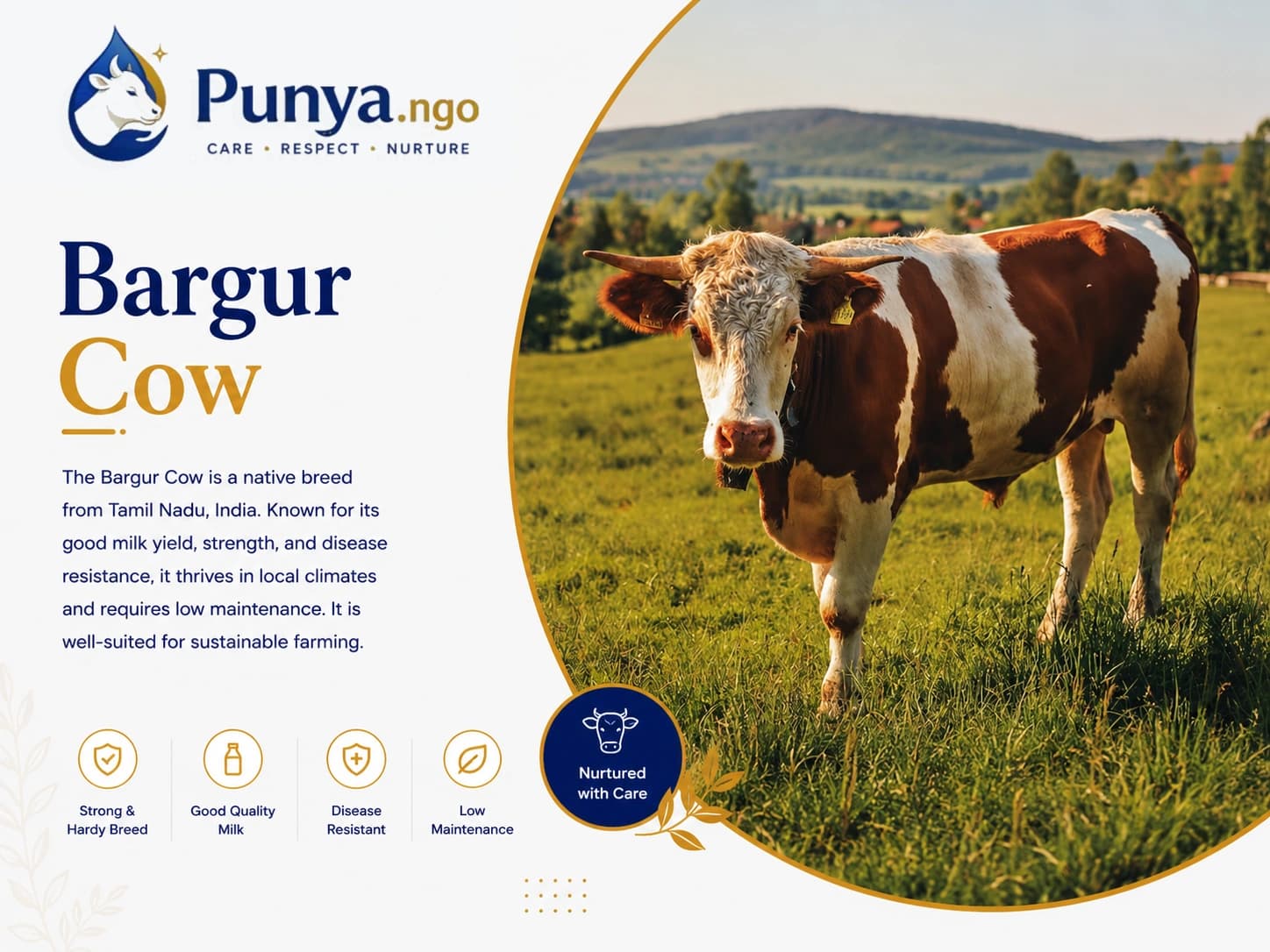
Bargur Cow Breed in India: Origin, Characteristics, Milk Production, and Farming Value
Bargur Cow Breed in India is a hardy indigenous cattle breed known for its exceptional stamina, strong grazing ability, and adaptability to challenging environments. Native to the forested and hilly regions of Tamil Nadu, this desi cow breed has traditionally supported rural farming systems through draft work, natural grazing efficiency, and resilience under low-input management conditions.
Unlike specialized dairy breeds, the Bargur cow is valued primarily for its endurance, disease resistance, and ability to thrive in rugged terrain. For farmers operating in dry, hilly, or forest-fringe regions, it remains an important part of traditional livestock-based agriculture.
Takeaway: The Bargur cow is best known for strength, adaptability, and survival in demanding farming environments rather than high milk production.
What is Bargur Cow Breed in India?
The Bargur Cow Breed in India is an indigenous breed of Indian cattle that originated in southern India. It belongs to the group of native cattle developed through generations of natural adaptation to local climatic conditions and extensive grazing systems.
Traditionally, Bargur cattle have been used for agricultural work, transportation, and maintaining sustainable rural livelihoods. Their ability to travel long distances in search of forage makes them particularly suited to extensive farming systems.
Takeaway: Bargur cattle are a traditional Indian breed valued for utility, endurance, and adaptability.
Origin and Native Region
The Bargur breed takes its name from the Bargur Hills located in Erode district of Tamil Nadu. The breed developed over many generations within this unique ecosystem characterized by forests, hills, uneven terrain, and seasonal rainfall patterns.
Quick Overview
| Feature | Details |
|---|---|
| Breed Name | Bargur |
| State | Tamil Nadu |
| Native Region | Bargur Hills |
| Category | Indigenous cattle breed |
| Primary Utility | Draft work and rural farming |
| Farming System | Extensive grazing |
| Climate Suitability | Dry, hilly, and semi-arid regions |
The local environment played a significant role in shaping the breed's physical strength, agility, and hardiness.
Takeaway: The Bargur breed evolved naturally in the hilly landscapes of Tamil Nadu, making it highly adapted to similar conditions.
Physical Characteristics
The Bargur Cow Breed in India has a distinctive appearance that reflects its active lifestyle and working ability.
Key Physical Traits
- Medium-sized body structure
- Compact and muscular build
- Coat usually ranges from brown to reddish-brown
- White markings may appear on various parts of the body
- Strong legs and hard hooves
- Medium-sized horns that curve backward and outward
- Alert facial expression
- Well-developed shoulders and limbs
One of the most noticeable characteristics of Bargur cattle is their athletic appearance. They are agile animals capable of moving efficiently across steep and uneven terrain.
Takeaway: Strong legs, muscular build, and agility make Bargur cattle naturally suited for rugged landscapes.
Milk Production and Dairy Value
When discussing milk production, it is important to understand that the Bargur Cow Breed in India is not considered a specialized dairy breed.
Milk yield generally remains modest compared to high-producing indigenous breeds or commercial dairy cattle. However, the milk produced is often valued in traditional rural households where cattle serve multiple purposes beyond dairy production.
Dairy Characteristics
| Parameter | Details |
|---|---|
| Milk Yield | Low to Moderate |
| Dairy Focus | Household Use |
| Commercial Dairy Suitability | Limited |
| Maintenance Cost | Relatively Low |
| Multi-Purpose Utility | High |
Farmers typically keep Bargur cattle for their overall utility rather than milk alone.
Takeaway: Bargur cows provide milk for household and small-scale needs but are not primarily raised for commercial dairy farming.
Temperament and Behavior
The Bargur Cow Breed in India is known for being active, alert, and energetic.
Due to generations of semi-wild grazing and forest-based management, these animals often display a more independent temperament than stall-fed dairy breeds. They are highly responsive to their surroundings and possess strong survival instincts.
Behavioral Traits
- Alert and observant
- Active grazers
- High stamina
- Good mobility
- Strong herd behavior
- Adapted to open grazing environments
Takeaway: Bargur cattle are energetic and alert animals best suited to farmers experienced with active grazing breeds.
Climate Adaptability
One of the biggest strengths of the Bargur Cow Breed in India is its climate adaptability.
The breed has evolved under conditions that include:
- High temperatures
- Seasonal feed shortages
- Long grazing distances
- Uneven terrain
- Variable rainfall patterns
Adaptation Advantages
- Excellent heat tolerance
- Efficient use of natural grazing resources
- Strong resistance to environmental stress
- Performs well in low-input systems
- Capable of thriving in semi-arid regions
These qualities make Bargur cattle attractive for sustainable and climate-resilient farming practices.
Takeaway: Heat tolerance and environmental resilience are among the strongest advantages of the Bargur breed.
Feeding and Management
The Bargur Cow Breed in India performs best under extensive or semi-extensive management systems.
Feeding Requirements
- Natural grasses
- Forest vegetation
- Crop residues
- Fodder crops when available
- Mineral supplementation
- Clean drinking water
Management Practices
- Regular health monitoring
- Vaccination schedules
- Parasite control
- Access to grazing land
- Adequate shelter during extreme weather
Because the breed is naturally hardy, maintenance costs are often lower than those of highly specialized commercial breeds.
Takeaway: Proper grazing management and basic healthcare are usually sufficient to maintain healthy Bargur cattle.
Advantages of Bargur Cow Breed in India
Major Advantages
- Excellent heat tolerance
- Strong disease resistance
- High stamina and endurance
- Efficient grazing ability
- Lower maintenance requirements
- Adaptability to difficult terrain
- Valuable for sustainable farming systems
- Suitable for low-input agriculture
Takeaway: Bargur cattle excel in low-cost, resource-efficient farming environments.
Limitations or Practical Considerations
Every cattle breed has limitations, and the Bargur Cow Breed in India is no exception.
Practical Challenges
- Lower milk production compared to dairy-focused breeds
- Less suitable for intensive dairy businesses
- Requires access to grazing areas
- Active temperament may require experienced handling
- Limited availability outside native regions
Farmers should align breed selection with their production goals rather than choosing solely based on breed popularity.
Takeaway: Bargur cattle are ideal for utility and resilience, but not for farmers seeking maximum dairy output.
Best Use Cases for Farmers
The Bargur Cow Breed in India is particularly suitable for:
- Hilly farming regions
- Forest-fringe villages
- Semi-arid agricultural zones
- Traditional mixed farming systems
- Sustainable livestock operations
- Low-input cattle rearing models
Farmers looking for hardy cattle capable of utilizing natural resources efficiently may find Bargur cattle highly valuable.
Takeaway: Bargur cattle are most effective in traditional, extensive, and climate-resilient farming systems.
Comparison with Similar Indian Cow Breeds
Bargur vs Kangayam
| Feature | Bargur | Kangayam |
|---|---|---|
| Native Region | Bargur Hills, Tamil Nadu | Tamil Nadu |
| Primary Use | Draft and Utility | Draft and Utility |
| Terrain Adaptation | Hilly and Forest Areas | Dry Plains |
| Temperament | Active and Alert | Relatively Calm |
| Milk Yield | Low to Moderate | Low to Moderate |
| Grazing Ability | Excellent | Very Good |
| Endurance | Excellent | Excellent |
While both are respected indigenous breeds, Bargur cattle are generally considered better adapted to rugged and hilly landscapes.
Takeaway: Compared with Kangayam cattle, Bargur cattle show stronger adaptation to steep terrain and forest-based grazing systems.
Conclusion
The Bargur Cow Breed in India represents the strength and adaptability of traditional Indian cattle genetics. Developed in the challenging landscapes of Tamil Nadu's Bargur Hills, the breed has earned recognition for its endurance, heat tolerance, grazing efficiency, and suitability for low-input farming systems.
Although it is not a high-yield dairy breed, its value lies in resilience, sustainability, and practical utility. For farmers operating in semi-arid, hilly, or extensive grazing environments, Bargur cattle remain a dependable and economically sensible choice.
Takeaway: The Bargur breed is a practical indigenous cattle option for farmers who prioritize resilience, adaptability, and long-term sustainability over maximum milk production.
FAQs
1. What is the Bargur Cow Breed in India known for?
The breed is known for endurance, heat tolerance, strong grazing ability, and adaptability to hilly terrain.
2. Which state is the Bargur cow native to?
The Bargur cow originates from Tamil Nadu, particularly the Bargur Hills region.
3. Is the Bargur cow a good dairy breed?
It produces milk but is generally not considered a specialized dairy breed.
4. Can Bargur cattle tolerate hot climates?
Yes. The breed has excellent heat tolerance and performs well in warm and semi-arid conditions.
5. What type of farming system suits Bargur cattle?
They are best suited to extensive grazing systems, mixed farming, and low-input livestock operations.
6. Are Bargur cattle suitable for hilly areas?
Yes. Their strong legs, agility, and stamina make them particularly effective in hilly and uneven terrain.
7. How do Bargur cattle compare with Kangayam cattle?
Both are hardy indigenous breeds, but Bargur cattle generally show stronger adaptation to forested and hilly landscapes.
8. Why are indigenous breeds like Bargur important?
Indigenous breeds help preserve genetic diversity, support sustainable farming, and perform well under local environmental conditions.