
Why Cows Were Considered Wealth in Ancient India
Discover why cows were considered wealth in ancient India and explore their role in agriculture, village life, dairy traditions, and sustainable living.
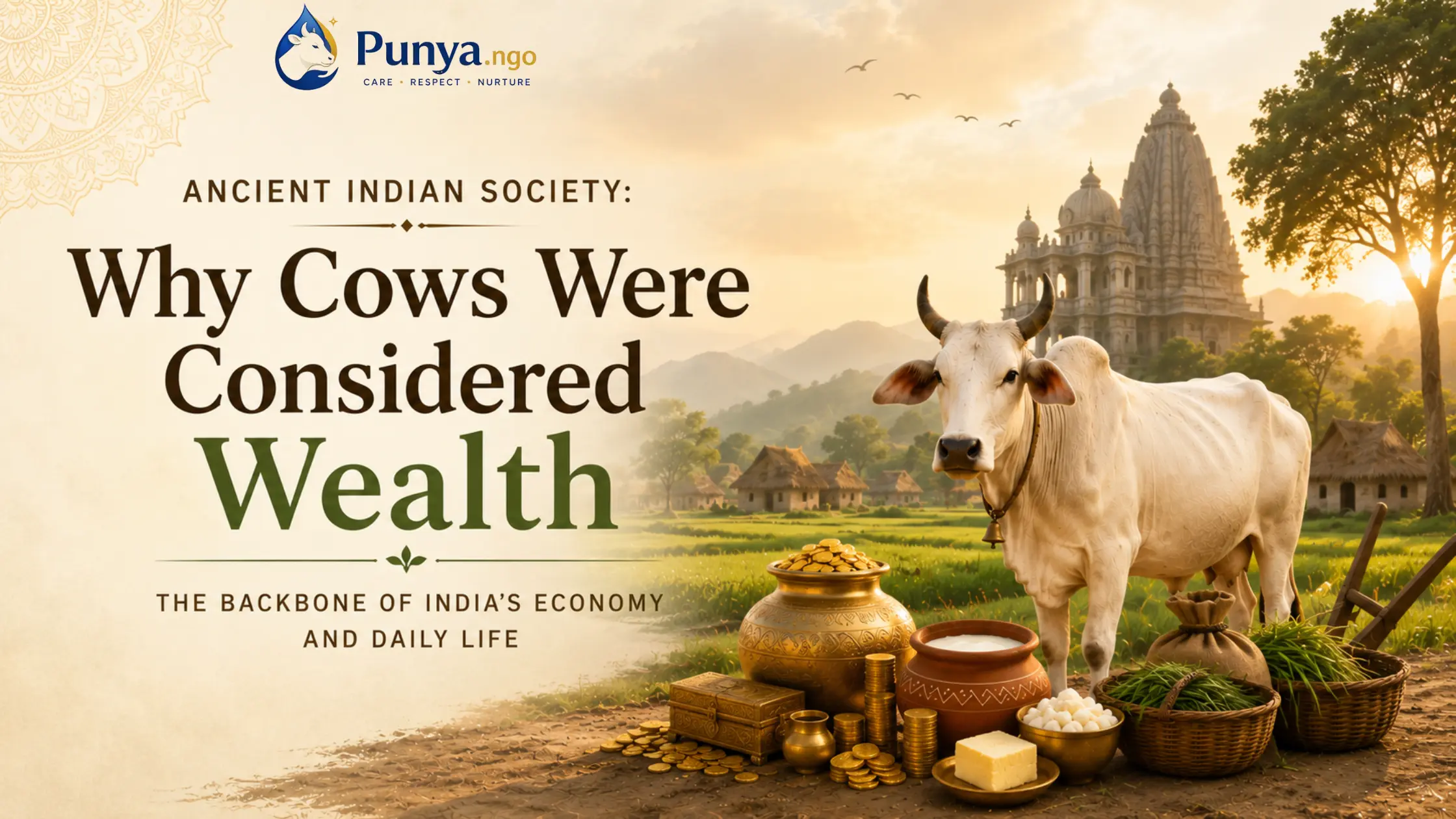
Ancient Indian Society: Why Cows Were the Backbone of India's Economy and Daily Life
Ancient Indian civilization flourished through a harmonious relationship between humans, nature, agriculture, and livestock. At the center of this interconnected system was the cow, an animal that supported nearly every aspect of daily life. Far from being valued solely for its milk, the cow was considered a source of prosperity, agricultural strength, nutritional security, and sustainable living. Historical evidence from Vedic literature, ancient scriptures, archaeological discoveries, and historical records suggests that cattle played a crucial role in shaping India's economic and social foundations.
Unlike modern economies that depend heavily on currency and industrial production, the economy of ancient India was largely agrarian. Families relied on fertile land, seasonal farming, and healthy cattle to sustain their livelihoods. Cows supplied milk and dairy products for daily nutrition, while bullocks powered agricultural activities such as ploughing, irrigation, and transportation. Cow dung served as an effective organic fertilizer and a renewable source of household fuel, making cattle indispensable to both farming and village life.
Ancient Indian texts such as the Rigveda, Atharvaveda, Mahabharata, and Arthashastra frequently mention cattle as symbols of prosperity and economic well-being. A family's wealth was often measured by the number of healthy cows it owned, reflecting the practical value of cattle in supporting long-term food security and agricultural productivity.
This article explores how cows became the backbone of ancient Indian society by examining their role in wealth creation, the cattle-based economy, agriculture, and the development of indigenous cow breeds that continue to influence Indian farming today.
Why Were Cows Considered Wealth in Ancient India?
Quick Answer: In ancient India, cows were regarded as wealth because they continuously provided food, farming support, natural resources, and economic security. Unlike material possessions, cattle generated long-term value through milk production, breeding, agriculture, and trade.
The concept of wealth in ancient India differed significantly from today's understanding of money and financial assets. While gold, silver, and land were valuable, cattle represented a form of living wealth that could continuously support a family's livelihood.
Ancient Sanskrit literature frequently uses the word "Go" (cow) as a symbol of prosperity, abundance, and well-being. The Rigveda contains numerous references to cattle as indicators of wealth, while kings often rewarded scholars, priests, and warriors with cows instead of coins or precious metals.
One of the greatest advantages of owning cattle was their ability to generate value throughout their lives. A healthy cow provided milk every day, which could be consumed directly or converted into products such as curd, butter, buttermilk, and ghee. Calves born from these cows increased a family's livestock, while male calves eventually became bullocks capable of supporting agriculture and transportation.
For rural households, cattle represented financial stability. During difficult times, families could exchange livestock for grain, land, or essential goods, making cows one of the most reliable economic assets in ancient society.
Why Cows Symbolized Wealth
- Continuous source of milk and dairy products
- Supported farming through bullocks
- Increased family assets through breeding
- Produced organic manure for agriculture
- Strengthened food security
- Generated opportunities for trade
- Represented prosperity and abundance
Ancient Assets and Their Importance
| Asset | Importance in Ancient Indian Society |
|---|---|
| Cow | Milk, wealth, farming support, dairy |
| Bullock | Ploughing, irrigation, transportation |
| Agricultural Land | Crop cultivation and food production |
| Grain | Daily nutrition and trade |
| Gold | Commerce and ornaments |
Economy Based on Cattle
Quick Answer: Ancient India's rural economy depended heavily on cattle because they supported agriculture, transportation, dairy production, and local trade. Healthy livestock directly contributed to stronger village economies and greater household prosperity.
Before the development of modern banking and industrial systems, cattle served as one of the most dependable economic resources. Ancient Indian villages operated on a mixed agricultural economy where farming and livestock complemented one another.
Bullocks supplied the physical power required for agricultural activities, while cows produced milk that nourished families and generated additional income through dairy products. This combination ensured that households had multiple sources of livelihood instead of depending solely on crop cultivation.
Historical works such as the Arthashastra, written by Kautilya, describe the importance of livestock management within the state's administrative system. Protecting cattle was considered essential because agricultural productivity and tax revenues depended heavily on healthy livestock populations.
Dairy products including milk, curd, butter, buttermilk, and ghee were widely exchanged within villages and neighboring regions. Ghee became especially valuable because it had a longer shelf life and was used for cooking, hospitality, and religious ceremonies.
Cattle also functioned as movable wealth. Unlike land, livestock could be traded, gifted, or exchanged whenever families needed financial support. This flexibility made cattle an important pillar of the rural economy.
Major Economic Contributions of Cattle
- Supported agricultural production
- Generated dairy-based income
- Encouraged local trade and exchange
- Reduced economic risk for farming families
- Strengthened village self-sufficiency
- Increased food availability
- Created long-term household wealth
Agriculture and the Cow
Quick Answer: Cows and bullocks formed the foundation of ancient Indian agriculture by providing draft power, natural fertilizer, transportation, and a sustainable farming system that maintained soil fertility for generations.
Agriculture was the primary occupation of ancient Indian society, and successful farming depended heavily on cattle. Bullocks were especially valuable because they performed physically demanding tasks that allowed farmers to cultivate large areas without mechanical equipment.
Using wooden ploughs pulled by bullocks, farmers prepared fields before sowing crops. The same animals transported seeds, harvested produce, farming tools, and irrigation equipment between fields and villages.
Equally important was the contribution of cow dung. Ancient farmers understood that healthy soil produced healthy crops. Rather than treating dung as waste, they applied it to agricultural land as a natural fertilizer that improved soil structure and nutrient availability.
Cow dung was also mixed with crop residues to create compost, allowing nutrients to return naturally to the soil. This practice reduced waste while improving long-term agricultural productivity.
The close relationship between crops and cattle created a sustainable agricultural cycle. Crops provided fodder for livestock, while livestock supplied manure that enriched future harvests. This natural cycle helped ancient Indian farmers maintain soil fertility without relying on synthetic chemicals.
Agricultural Benefits of Cows
- Bullocks ploughed agricultural fields
- Transported crops and farming equipment
- Improved soil fertility through manure
- Supported irrigation activities
- Reduced dependence on external resources
- Increased long-term farm productivity
Traditional Farming Cycle
| Farming Activity | Role of Cows and Bullocks |
|---|---|
| Land Preparation | Bullocks pulled wooden ploughs |
| Seed Sowing | Assisted in preparing cultivated land |
| Irrigation | Transported water and equipment |
| Harvest | Carried harvested crops |
| Soil Improvement | Cow dung enriched agricultural fields |
Indigenous Cow Breeds in Ancient India
Quick Answer: Indigenous Indian cow breeds evolved naturally over centuries to suit local climates, making them highly resilient, disease-resistant, and valuable for dairy production as well as agricultural work.
India has long been recognized for its rich diversity of indigenous cattle breeds. These native breeds adapted naturally to regional climates, making them well suited to local farming conditions.
Unlike many imported breeds, indigenous cows generally required fewer external inputs and could thrive on locally available fodder. Their adaptability helped farmers maintain livestock even in regions affected by drought, heat, or limited resources.
Ancient livestock keepers preserved desirable traits such as endurance, fertility, disease resistance, and strength through careful breeding practices. Strong bullocks produced by these breeds became indispensable for ploughing fields and transporting goods across rural India.
Even today, several indigenous breeds continue to play an important role in sustainable agriculture because of their resilience and ability to perform well under diverse environmental conditions.
Prominent Indigenous Cow Breeds
Gir
Originating from Gujarat, the Gir breed is well known for its milk production, heat tolerance, and adaptability to tropical climates.
Sahiwal
Native to the Punjab region, Sahiwal cattle are recognized for their excellent dairy performance and resistance to harsh weather conditions.
Tharparkar
Developed in the arid regions of Rajasthan, the Tharparkar breed is valued for its drought tolerance and ability to thrive under challenging climatic conditions.
Red Sindhi
This breed has traditionally been appreciated for consistent milk production and adaptability to warm environments.
Ongole
Originating from present-day Andhra Pradesh, Ongole cattle are famous for producing powerful bullocks used extensively in traditional agriculture.
Comparison of Indigenous Cow Breeds
| Breed | Region | Primary Strength |
|---|---|---|
| Gir | Gujarat | High milk production |
| Sahiwal | Punjab | Dairy performance and adaptability |
| Tharparkar | Rajasthan | Drought resistance |
| Red Sindhi | Sindh | Reliable milk production |
| Ongole | Andhra Pradesh | Strong agricultural bullocks |
Key Takeaways
- Cows were considered living wealth because they generated continuous economic value.
- Ancient India's economy relied heavily on cattle for agriculture, dairy production, and trade.
- Bullocks formed the backbone of traditional farming systems.
- Cow dung supported sustainable agriculture through natural soil enrichment.
- Indigenous Indian cattle breeds contributed significantly to the success of ancient agriculture due to their resilience and adaptability.
Village Life and Cow Culture
Quick Answer: Cows were at the heart of village life in ancient India. They provided food, supported agriculture, strengthened the local economy, and fostered a culture of cooperation, making villages largely self-sufficient and sustainable.
Ancient Indian villages were designed around a self-reliant way of life, where agriculture and livestock worked together to meet the needs of the community. Among all domesticated animals, cows occupied a central position because they contributed to food production, farming, transportation, and household livelihoods.
Most farming families owned one or more cows, while wealthier households often maintained larger herds. Community grazing lands, water sources, and cattle shelters were common features of village life. Farmers understood that healthy livestock meant better harvests and improved living standards.
Village communities also shared responsibilities related to cattle care. During seasonal migrations, droughts, or festivals, people worked together to protect and manage their livestock. This collective approach strengthened social bonds and promoted mutual support.
Beyond economics, cows became symbols of hospitality and generosity. Offering milk, curd, or buttermilk to guests reflected the values of respect and community that characterized ancient Indian culture.
Key Features of Cow Culture in Villages
- Cows were owned by most farming households.
- Villages maintained common grazing lands.
- Bullocks supported cultivation and transport.
- Dairy products formed part of the daily diet.
- Families passed cattle-rearing knowledge through generations.
- Livestock strengthened community cooperation.
- Villages became economically self-sufficient.
Cow Products in Daily Life
Quick Answer: Every product obtained from cows served a practical purpose in ancient India. Milk, curd, butter, ghee, dung, and other by-products contributed to nutrition, agriculture, household activities, and traditional practices.
One of the reasons cows were highly valued was their ability to provide multiple renewable resources throughout their lives. Unlike many other assets, cows continuously benefited households without being exhausted after a single use.
Milk served as the primary source of nutrition and was consumed by children and adults alike. Families converted surplus milk into curd, butter, buttermilk, and ghee to increase its shelf life and nutritional value.
Cow dung was another valuable resource. Farmers applied it as organic manure to improve soil fertility, while dried dung cakes provided an affordable source of cooking fuel. In many regions, cow dung mixed with clay was traditionally used to coat floors and walls because of its insulating properties.
Traditional Indian agriculture also recognized the importance of Panchagavya, a mixture prepared using five cow-derived products—milk, curd, ghee, dung, and urine. It has historically been used in certain religious ceremonies and traditional farming practices.
Everyday Uses of Cow Products
| Cow Product | Traditional Use | Present-Day Relevance |
|---|---|---|
| Milk | Daily nutrition | Dairy industry |
| Curd | Household food | Probiotic food |
| Butter | Cooking | Dairy products |
| Ghee | Food and rituals | Culinary and ceremonial use |
| Buttermilk | Refreshing drink | Traditional beverage |
| Cow Dung | Organic manure | Organic farming |
| Dung Cakes | Cooking fuel | Biomass energy |
| Cow Urine | Traditional agriculture and rituals | Natural farming practices |
Sustainable Living Through Cows
Quick Answer: Ancient Indian society practiced a sustainable lifestyle by integrating cattle with agriculture, ensuring that every resource was reused efficiently and very little went to waste.
Long before concepts like the circular economy, zero waste, and sustainable agriculture became popular, ancient Indian villages had already adopted similar principles in everyday life.
The relationship between crops and cattle created a continuous cycle of resource utilization. Crops provided fodder for cows, while cows produced manure that enriched agricultural fields. Healthy soil resulted in better harvests, creating a self-sustaining farming ecosystem.
This integrated farming system reduced dependence on external resources and minimized waste generation. Instead of discarding by-products, families reused them in farming, cooking, and household maintenance.
Circular Economy of Ancient India
          Cow
           │
           ▼
   Milk & Dairy Products
           │
           ▼
     Healthy Families
           │
           ▼
       Cow Dung
           │
           ▼
    Organic Fertilizer
           │
           ▼
      Fertile Soil
           │
           ▼
      Healthy Crops
           │
           ▼
      Crop Residues
           │
           ▼
       Cattle Feed
           │
           └────────────► Back to Cow
Sustainability Benefits
- Natural recycling of resources
- Improved soil fertility
- Renewable household resources
- Lower environmental impact
- Reduced agricultural waste
- Stronger village economy
- Long-term food security
Cow and Organic Farming
Quick Answer: Ancient Indian farming relied on natural resources instead of synthetic chemicals. Cow dung and other locally available materials helped maintain fertile soil and supported sustainable agricultural practices.
Organic farming was simply the traditional way of farming in ancient India. Farmers depended on natural cycles rather than manufactured fertilizers or pesticides.
Cow dung played an essential role in maintaining soil health. It was composted and applied to fields to improve soil structure, nutrient availability, and water retention. Farmers recognized that healthy soil produced healthier crops and ensured better harvests over time.
Traditional agricultural preparations prepared from locally available resources—including formulations using cow-derived products—were also used in some farming systems to support crop growth. Today, many natural farming initiatives continue to study and adapt these traditional practices.
Organic Farming vs Chemical Farming
| Organic Farming | Chemical Farming |
|---|---|
| Natural manure | Synthetic fertilizers |
| Supports soil biodiversity | May reduce biodiversity when overused |
| Uses renewable farm resources | Depends on manufactured inputs |
| Improves long-term soil health | Can degrade soil if mismanaged |
| Environmentally sustainable | Higher pollution risk |
The principles followed by ancient Indian farmers continue to inspire modern organic and regenerative farming systems.
Ancient Dairy Traditions
Quick Answer: Dairy production was an essential household activity in ancient India. Families processed fresh milk into nutritious products such as curd, butter, buttermilk, and ghee for daily use.
Milk was considered one of the most valuable foods because it was nutritious, versatile, and could be preserved in different forms. Every household developed methods to process fresh milk into products that lasted longer and served various culinary purposes.
Curd became a staple part of meals, while butter and buttermilk were prepared regularly using traditional churning methods. Ghee held special importance because of its long shelf life and widespread use in cooking, hospitality, and religious ceremonies.
Traditional dairy knowledge was passed from one generation to another, helping families maximize the value of their livestock while minimizing food waste.
Common Dairy Products
- Fresh milk
- Curd (Yogurt)
- Butter
- Ghee
- Buttermilk
- Traditional milk-based sweets
Why Every Home Kept Cows
Quick Answer: Families kept cows because they provided nutrition, farming support, natural fertilizer, renewable resources, and financial security, making them one of the most valuable household assets.
Owning a cow was both an economic necessity and a practical investment in ancient India. A single cow could nourish an entire family through milk while also contributing to agriculture through its offspring.
Bullocks born within the household eventually became valuable draft animals used for ploughing fields and transporting goods. Cow dung improved agricultural productivity, reducing the need for external farming inputs.
Surplus dairy products could be exchanged or sold within local markets, providing an additional source of household income. This diversified livelihood helped families remain financially stable even during difficult agricultural seasons.
Benefits of Keeping Cows
- Daily milk supply
- Better family nutrition
- Organic manure for farming
- Bullocks for agricultural work
- Additional household income
- Renewable natural resources
- Food security
- Self-sufficient rural lifestyle
Lessons Modern Society Can Learn from Ancient Indian Cow Culture
Ancient India's cattle-based economy demonstrates how sustainable living can be achieved through the responsible use of natural resources. Integrating livestock with agriculture helped reduce waste, improve soil health, and strengthen local food systems.
Today, farmers and environmentalists are increasingly recognizing the importance of soil conservation, organic farming, biodiversity, and circular resource management. Many of these ideas closely resemble practices followed in ancient Indian villages.
However, it is equally important to combine traditional knowledge with modern agricultural science. Scientific research, improved animal welfare, sustainable farming techniques, and responsible environmental management can work together to create resilient farming systems for the future.
Conclusion
Cows played a fundamental role in shaping ancient Indian society by supporting agriculture, nutrition, trade, and village life. They were far more than domesticated animals—they represented renewable wealth, economic resilience, and sustainable living.
From providing milk and dairy products to strengthening agriculture through bullocks and natural manure, cows contributed to nearly every aspect of rural life. Indigenous cattle breeds further enhanced agricultural productivity by adapting to diverse climatic conditions across the Indian subcontinent.
The close relationship between humans, cattle, and agriculture allowed ancient Indian villages to become largely self-sufficient while maintaining ecological balance. Many of these traditional principles continue to inspire sustainable agriculture and environmental conservation today.
Understanding the historical significance of cows helps us appreciate how ancient India built a civilization based on harmony with nature, responsible resource management, and long-term sustainability.
Frequently Asked Questions (FAQs)
Why were cows considered wealth in ancient India?
Cows were considered wealth because they provided milk, dairy products, natural manure, bullocks for farming, and long-term economic security.
How did cows contribute to agriculture?
Bullocks ploughed fields, transported crops, and supported irrigation, while cow dung improved soil fertility as a natural fertilizer.
What products were obtained from cows?
Milk, curd, butter, ghee, buttermilk, manure, dung cakes, and traditional agricultural inputs.
Why did almost every household own cows?
Owning cows ensured food security, agricultural productivity, renewable resources, and financial stability.
What is Panchagavya?
Panchagavya is a traditional mixture made from milk, curd, ghee, dung, and urine, historically used in certain religious practices and traditional agriculture.
Which indigenous cow breeds are famous in India?
Gir, Sahiwal, Tharparkar, Red Sindhi, and Ongole are among India's most recognized indigenous cattle breeds.
How did cows support sustainable living?
Cows supplied renewable resources such as milk and manure while supporting agriculture through a natural cycle of nutrient recycling.
What lessons can modern farming learn from ancient India?
Modern agriculture can learn the importance of soil health, integrated farming, organic manure, biodiversity conservation, and sustainable resource management.