Hariana Cow Breed in India | Origin, Milk Yield
Learn about the Hariana Cow Breed in India, including origin, milk yield, characteristics, care, advantages, and farming value.
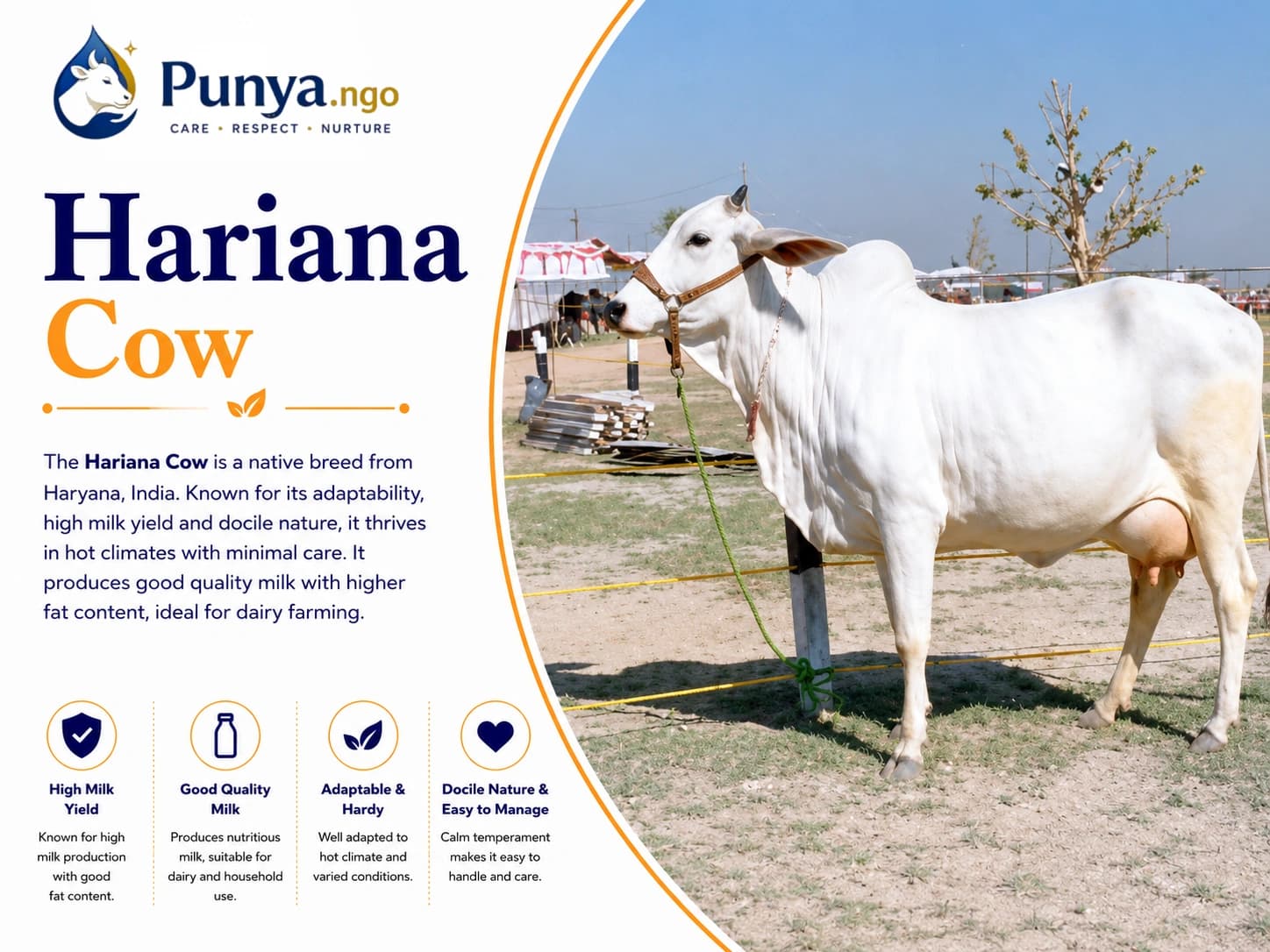
Hariana Cow Breed in India
The Hariana Cow Breed in India is one of the most respected indigenous cattle breeds of North India. Known for its dual-purpose utility, this breed is valued for both milk production and agricultural work. Farmers appreciate Hariana cattle for their strength, adaptability, heat tolerance, and ability to perform well under traditional farming conditions.
Unlike specialized dairy breeds that require intensive management, the Hariana Cow Breed in India is known for its practical value in rural farming systems. It combines moderate milk yield with excellent working ability, making it a reliable choice for many farmers.
Takeaway: The Hariana breed is a balanced indigenous cattle breed valued for milk, draught power, and adaptability.
What is Hariana Cow Breed in India?
The Hariana Cow Breed in India is a well-known indigenous breed originating from the northern plains of India. It belongs to the group of Indian zebu cattle and has traditionally been used for both milk production and farm work.
The breed is particularly famous for producing strong bullocks that are capable of working long hours in agricultural fields. At the same time, Hariana cows provide a useful quantity of milk for household and small-scale dairy needs.
Takeaway: Hariana is a dual-purpose desi cow breed developed for both milk production and agricultural utility.
Origin and Native Region
The Hariana Cow Breed in India originated in the state of Haryana and surrounding regions. The breed is commonly found in:
- Haryana
- Western Uttar Pradesh
- Parts of Rajasthan
- Delhi region
The breed evolved under hot climatic conditions and traditional farming systems, which helped it develop strong adaptability and endurance.
Native Environment
| Aspect | Details |
|---|---|
| Origin State | Haryana |
| Distribution | Haryana, Uttar Pradesh, Rajasthan |
| Breed Type | Indigenous Dual-Purpose Breed |
| Farming System | Rural and Semi-Intensive |
| Climate | Hot and Semi-Arid |
Takeaway: Hariana cattle are naturally adapted to the climatic and agricultural conditions of North India.
Physical Characteristics
The Hariana Cow Breed in India has a distinctive appearance that reflects its strength and working ability.
Key Physical Features
- Medium to large body size
- Predominantly white or light grey coat
- Dark shading around neck and shoulders in males
- Long and narrow face
- Small curved horns
- Strong legs and well-developed muscles
- Prominent hump typical of Indian cattle
Bullocks are especially known for their stamina and are considered among the best working cattle in northern India.
Takeaway: Hariana cattle have a strong, athletic build designed for endurance and utility.
Milk Production and Dairy Value
Although the Hariana Cow Breed in India is not considered a high-yield dairy breed, it produces a respectable quantity of milk under traditional farming conditions.
Milk Production Overview
| Factor | Typical Performance |
|---|---|
| Milk Yield | Moderate |
| Lactation Performance | Suitable for rural dairying |
| Milk Quality | Nutritious and valued locally |
| Dairy Utility | Household and Small Dairy Farms |
Milk production depends on:
- Nutrition
- Management practices
- Health care
- Genetics
- Environmental conditions
Farmers often choose Hariana cattle because they provide a reasonable balance between milk production and maintenance costs.
Takeaway: Hariana cows offer moderate milk production with relatively low management requirements.
Temperament and Behavior
The Hariana Cow Breed in India is generally known for being active, alert, and hardworking.
Behavioral Traits
- Intelligent
- Energetic
- Good working temperament
- Adaptable to rural management
- Strong field performance
Proper handling from an early age helps maintain calm and manageable behavior.
Takeaway: Hariana cattle are hardworking animals with a temperament suited to traditional farming systems.
Climate Adaptability
One of the biggest strengths of the Hariana Cow Breed in India is its ability to thrive in challenging climatic conditions.
Adaptation Advantages
- Excellent heat tolerance
- Suitable for hot summers
- Performs well in semi-arid regions
- Better resistance to environmental stress than many exotic breeds
- Adapted to local diseases and parasites
This adaptability reduces management challenges and makes the breed suitable for many parts of northern India.
Takeaway: Hariana cattle perform particularly well in hot climates where adaptability is essential.
Feeding and Management
Like all cattle breeds, the Hariana Cow Breed in India benefits from proper feeding and care.
Recommended Feeding
- Green fodder
- Dry fodder
- Crop residues
- Mineral mixture
- Clean drinking water
Management Practices
- Regular vaccination
- Deworming schedule
- Clean housing
- Proper ventilation
- Routine health monitoring
Even though Hariana cattle are hardy, good management significantly improves productivity and overall health.
Takeaway: Consistent feeding and preventive health care help Hariana cattle perform at their best.
Advantages of Hariana Cow Breed in India
The breed offers several practical benefits for farmers.
Major Advantages
- Indigenous breed well adapted to Indian conditions
- Good heat tolerance
- Strong draught power
- Moderate milk production
- Lower maintenance requirements
- Suitable for rural farming systems
- Better adaptability than many exotic breeds
- Useful for both dairy and agricultural work
Takeaway: Hariana cattle provide a practical combination of productivity, strength, and resilience.
Limitations or Practical Considerations
No breed is perfect, and the Hariana Cow Breed in India also has some limitations.
Common Limitations
- Milk yield is lower than specialized dairy breeds
- Commercial dairy farms may prefer higher-producing breeds
- Productivity depends heavily on management quality
- Mechanization has reduced demand for draught animals in some regions
Farmers should choose the breed based on their actual farming goals rather than expectations of maximum milk production.
Takeaway: Hariana is best suited for balanced farming systems rather than intensive dairy operations.
Best Use Cases for Farmers
The Hariana Cow Breed in India is particularly suitable for:
Ideal Farming Situations
- Small and medium farms
- Mixed farming systems
- Traditional agriculture
- Regions with hot climates
- Farmers seeking low-input cattle
- Households requiring both milk and work animals
The breed remains highly valuable where versatility is more important than specialization.
Takeaway: Hariana cattle are most useful when farmers need both utility and adaptability.
Comparison with Similar Indian Cow Breeds
Hariana vs Sahiwal
| Feature | Hariana | Sahiwal |
|---|---|---|
| Primary Use | Dual Purpose | Dairy |
| Milk Yield | Moderate | Higher |
| Draught Ability | Excellent | Moderate |
| Heat Tolerance | High | High |
| Maintenance | Moderate | Moderate |
| Best For | Mixed Farming | Dairy Farming |
Sahiwal is generally preferred when milk production is the main objective. Hariana remains a better option when farmers need both milk and working animals.
Takeaway: Sahiwal focuses more on dairy, while Hariana offers a balanced mix of milk and agricultural utility.
Conclusion
The Hariana Cow Breed in India continues to hold an important place in Indian agriculture. Its combination of moderate milk production, strong draught capability, heat tolerance, and adaptability makes it a practical choice for many farmers.
While it may not compete with specialized dairy breeds in milk yield, it excels as a dependable indigenous breed that performs well under real-world farming conditions. For farmers seeking resilience, versatility, and lower-input management, the Hariana breed remains a valuable option.
Takeaway: The Hariana breed is a dependable indigenous cattle breed that offers long-term value through adaptability, utility, and balanced productivity.
FAQs
1. What is the Hariana Cow Breed in India?
The Hariana breed is an indigenous dual-purpose cattle breed known for milk production and agricultural work.
2. Which state is the Hariana breed native to?
The breed originated in Haryana and is also found in Uttar Pradesh and Rajasthan.
3. Is Hariana a dairy breed?
It is primarily a dual-purpose breed, producing moderate milk while also providing excellent draught power.
4. Is Hariana suitable for hot climates?
Yes. The breed is highly heat tolerant and performs well in hot and semi-arid regions.
5. What color is a Hariana cow?
Most Hariana cattle are white or light grey in color.
6. Why do farmers prefer Hariana cattle?
Farmers value them for adaptability, strength, moderate milk production, and lower maintenance needs.
7. Is Hariana better than Sahiwal?
It depends on the objective. Sahiwal is generally better for dairy production, while Hariana is better for combined milk and farm work.
8. Is the Hariana breed suitable for small farmers?
Yes. Its adaptability and low-input management requirements make it suitable for small and medium farmers.