Kangayam Cow Breed in India – Complete Farmer's Guide
Learn about the Kangayam Cow Breed in India, including origin, milk production, characteristics, climate suitability, feeding, advantages, and farming value.
Kangayam Cow Breed in India: Complete Guide to Origin, Milk Yield, Farming Value, and Management
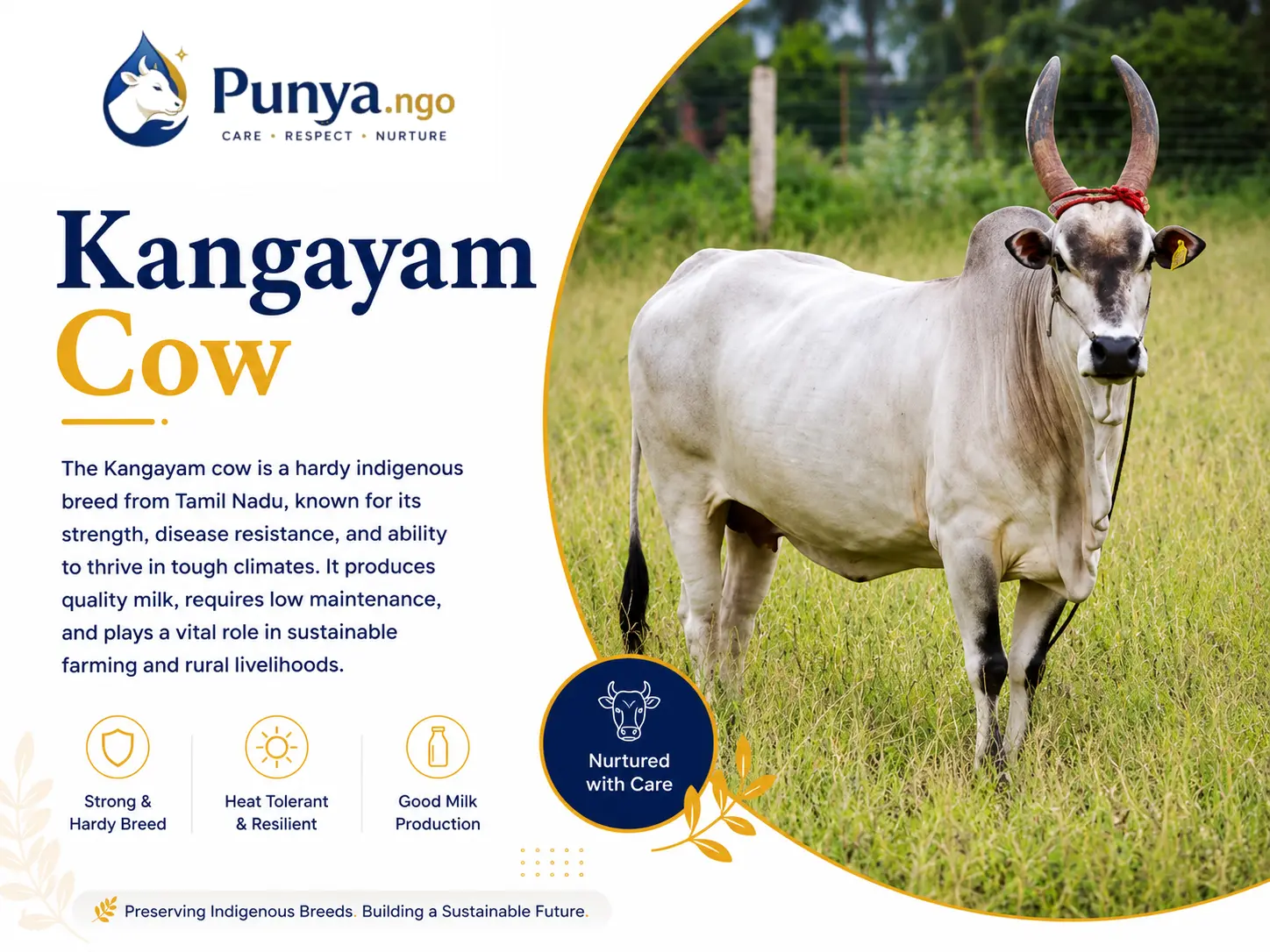
KangayamCow Breed in India is one of the most respected indigenous cattle breeds of South India. Originating from Tamil Nadu, this hardy desi cow is known for its strength, heat tolerance, adaptability, and usefulness in traditional farming systems.
Although the breed is not primarily famous for high milk production, it remains valuable for rural farming due to its durability, low maintenance requirements, and ability to thrive under challenging climatic conditions. Farmers appreciate Kangayam cattle for their resilience, work efficiency, and long-term utility.
Takeaway: Kangayam cattle are valued more for strength, adaptability, and sustainability than for high milk output.
What is KangayamCow Breed in India?
KangayamCow Breed in India is an indigenous cattle breed developed in the Kangayam region of Tamil Nadu. It belongs to the group of traditional Indian cattle breeds that have been selectively maintained for centuries by local farming communities.
The breed is particularly recognized for producing powerful bullocks that have historically been used for ploughing, cart pulling, and agricultural work. Today, it continues to play an important role in sustainable rural farming systems.
Takeaway: Kangayam is a traditional Indian cattle breed known primarily for strength, endurance, and agricultural utility.
Origin and Native Region
The Kangayam breed originated in the Kangayam area of Tiruppur district in Tamil Nadu. Over generations, local farmers selectively bred these cattle to withstand hot weather, limited feed resources, and demanding farm work.
Native Distribution
| Factor | Details |
|---|---|
| Origin State | Tamil Nadu |
| Native Region | Kangayam region |
| Breed Type | Indigenous cattle breed |
| Primary Utility | Draught and farming work |
| Climate | Semi-arid and tropical |
| Adaptability | High |
The breed is commonly found across western Tamil Nadu and neighboring regions where traditional farming practices remain important.
Takeaway: The breed evolved naturally in the dry regions of Tamil Nadu, making it highly adapted to local conditions.
Physical Characteristics
Kangayam cattle have a distinctive appearance that makes them easily recognizable among Indian cattle breeds.
Key Physical Features
- Medium-sized and compact body
- Strong muscular build
- Well-developed hump
- Broad forehead
- Short and sturdy legs
- Strong hooves
- Moderate-sized horns that curve outward and upward
- Grey, white, or steel-grey coat color
- Darker shades seen in bulls
Male animals are generally more muscular and heavier than females.
Appearance Overview
| Characteristic | Description |
|---|---|
| Body Size | Medium |
| Build | Compact and muscular |
| Coat Color | Grey to white |
| Horns | Curved and strong |
| Hump | Well developed |
| Heat Resistance | Excellent |
Takeaway: Kangayam cattle combine strength, durability, and structural efficiency in a compact body frame.
Milk Production and Dairy Value
Milk production is not the primary purpose of the KangayamCow Breed in India, but the breed contributes to household dairy needs in many rural areas.
Milk yield varies depending on feeding quality, genetics, management practices, and environmental conditions.
Dairy Characteristics
- Produces moderate quantities of milk
- Suitable for family-level consumption
- Milk contains good nutritional value
- Useful in mixed farming systems
- Lower milk output than specialized dairy breeds
Farmers focused exclusively on commercial dairy production often prefer breeds developed specifically for higher milk yields.
Takeaway: Kangayam cows provide moderate milk production and are best suited for mixed-purpose farming systems.
Temperament and Behavior
One of the breed's most appreciated qualities is its calm and manageable nature.
Behavioral Traits
- Intelligent
- Alert
- Hardy
- Obedient when trained
- Strong work ethic
- Capable of long working hours
Bullocks are especially known for their endurance and ability to perform agricultural tasks efficiently.
Takeaway: Kangayam cattle are dependable, manageable, and well-suited to traditional farming environments.
Climate Adaptability
Climate adaptability is one of the strongest advantages of the KangayamCow Breed in India.
These cattle evolved in regions characterized by:
- High temperatures
- Seasonal droughts
- Limited grazing resources
- Semi-arid landscapes
Adaptation Strengths
- Excellent heat tolerance
- Efficient water utilization
- Ability to survive on coarse fodder
- Resistance to environmental stress
- Good performance under extensive grazing systems
This makes the breed particularly valuable in areas where maintaining high-input cattle breeds can be difficult.
Takeaway: Kangayam cattle perform exceptionally well in hot, dry, and resource-limited environments.
Feeding and Management
Proper nutrition and management improve both productivity and overall animal health.
Feeding Recommendations
Green Fodder
- Napier grass
- Sorghum
- Maize fodder
- Cowpea fodder
Dry Fodder
- Straw
- Hay
- Crop residues
Supplements
- Mineral mixture
- Salt
- Clean drinking water
Management Practices
- Maintain clean housing
- Follow vaccination schedules
- Conduct regular deworming
- Provide shade during extreme heat
- Ensure access to grazing when possible
Because Kangayam cattle are naturally hardy, management costs are often lower than many high-producing dairy breeds.
Takeaway: Simple but consistent feeding and healthcare practices help maintain the breed's natural strengths.
Advantages of KangayamCow Breed in India
The breed offers several practical benefits to farmers.
Major Advantages
- Excellent heat tolerance
- Strong disease resistance
- Low maintenance requirements
- Long working life
- Adaptability to poor grazing conditions
- Efficient draught power
- Suitable for sustainable farming systems
- Lower feed costs compared to some specialized breeds
These qualities make Kangayam cattle attractive for farmers operating in challenging climatic conditions.
Takeaway: The breed's resilience and low-cost maintenance are among its biggest strengths.
Limitations or Practical Considerations
No cattle breed is perfect for every farming objective.
Considerations Before Choosing the Breed
- Lower milk yield than specialized dairy breeds
- Commercial dairy farmers may prefer higher-producing cattle
- Mechanization has reduced demand for draught animals in some regions
- Purebred conservation requires careful breeding management
Farmers should select the breed based on their actual farming goals rather than assuming one breed suits every situation.
Takeaway: Kangayam cattle excel in utility and adaptability but are not designed for maximum milk production.
Best Use Cases for Farmers
The KangayamCow Breed in India performs best in specific farming situations.
Ideal For
- Small and medium farmers
- Traditional agricultural systems
- Organic farming operations
- Low-input livestock management
- Semi-arid and drought-prone regions
- Mixed crop-livestock farming
- Indigenous breed conservation efforts
The breed is particularly valuable where durability and long-term sustainability matter more than maximizing milk output.
Takeaway: Kangayam cattle fit best into sustainable, mixed-farming, and resource-conscious agricultural systems.
Comparison with Similar Indian Cow Breeds
The Kangayam breed is often compared with Hallikar cattle because both are respected indigenous breeds with strong draught capabilities.
| Feature | Kangayam | Hallikar |
|---|---|---|
| Origin | Tamil Nadu | Karnataka |
| Primary Use | Draught and utility | Draught |
| Milk Production | Moderate | Lower to moderate |
| Heat Tolerance | Excellent | Excellent |
| Endurance | High | Very High |
| Maintenance Cost | Low | Low |
| Farming Utility | High | High |
While both breeds are highly adaptable, Kangayam cattle are often preferred in regions where farmers seek a balance between work utility and moderate milk production.
Takeaway: Kangayam and Hallikar are both strong indigenous breeds, but Kangayam offers a slightly broader mixed-purpose farming value.
Conclusion
KangayamCow Breed in India remains one of the country's most respected indigenous cattle breeds. Developed in Tamil Nadu and shaped by generations of practical farming needs, it stands out for strength, endurance, heat tolerance, and adaptability.
Although it is not a high-yield dairy breed, its value lies in sustainability, low maintenance requirements, and suitability for rural farming systems. For farmers seeking a hardy desi cow capable of performing well under challenging environmental conditions, Kangayam cattle continue to be a reliable and practical choice.
Takeaway: Kangayam cattle are a sustainable, resilient, and farmer-friendly breed that excels in real-world rural conditions.
FAQs
1. What is the KangayamCow Breed in India?
The Kangayam cow is an indigenous cattle breed from Tamil Nadu known for strength, endurance, and adaptability.
2. Which state is famous for Kangayam cattle?
Tamil Nadu is the native home of the Kangayam breed.
3. Is Kangayam a dairy breed?
It is primarily a utility and draught breed, though cows produce moderate amounts of milk.
4. Are Kangayam cattle suitable for hot climates?
Yes. The breed has excellent heat tolerance and performs well in semi-arid regions.
5. What is the main use of Kangayam bullocks?
They are traditionally used for ploughing, cart pulling, and agricultural work.
6. Is the Kangayam breed suitable for small farmers?
Yes. Its low maintenance requirements and adaptability make it suitable for small and medium-scale farmers.
7. How does Kangayam compare with Hallikar cattle?
Both are strong indigenous draught breeds, but Kangayam often offers slightly better mixed-purpose utility.
8. Why is the Kangayam breed important today?
It contributes to indigenous cattle conservation, sustainable agriculture, and climate-resilient farming systems.