
Malnad Gidda Cow Breed in India | Complete Guide
Learn about the Malnad Gidda Cow Breed in India, including origin, milk production, traits, farming value, adaptability, feeding, and management.
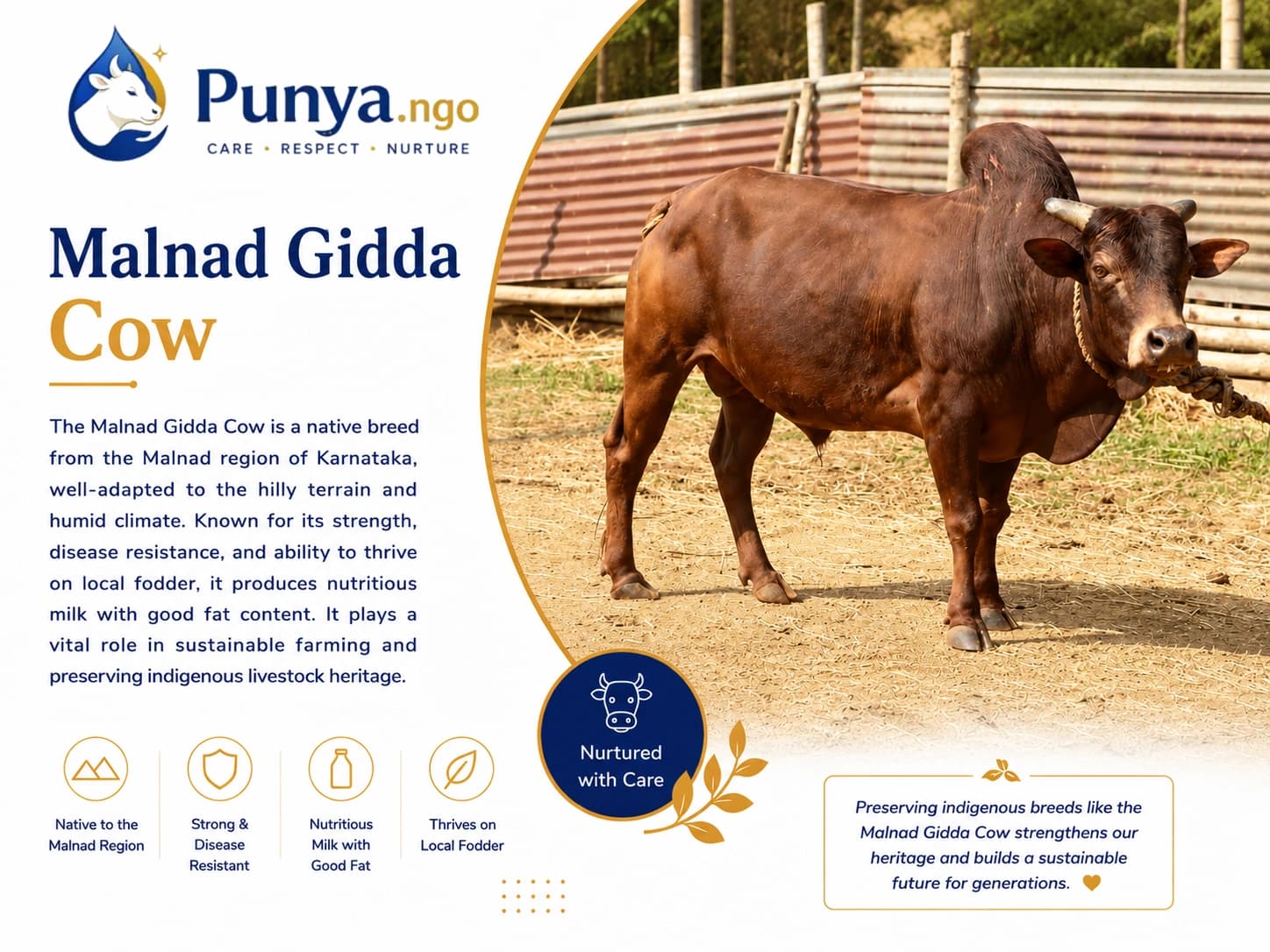
Malnad Gidda Cow Breed in India: A Hardy Indigenous Cattle Breed of the Western Ghats
Malnad Gidda Cow Breed in India is a small-sized indigenous cattle breed native to the hilly and forested regions of Karnataka. Known for its hardiness, disease resistance, and ability to thrive under low-input farming systems, this desi cow breed holds an important place in traditional rural agriculture.
Unlike high-yield exotic breeds that often require intensive management, Malnad Gidda cattle are valued for their adaptability, efficient feed utilization, and suitability for small-scale farmers. Although their milk yield is modest, their overall utility and resilience make them a practical choice in specific farming conditions.
Takeaway: The Malnad Gidda Cow Breed in India is valued more for adaptability, resilience, and low maintenance than for high milk production.
What is Malnad Gidda Cow Breed in India?
The Malnad Gidda Cow Breed in India is an indigenous breed originating from the Malnad region of Karnataka. The term "Gidda" means small or dwarf, reflecting the breed's compact body size.
This breed has evolved over generations in challenging environments characterized by dense forests, heavy rainfall, uneven terrain, and limited fodder availability. As a result, it developed exceptional survival abilities and natural resistance to many local challenges.
Quick Facts
| Feature | Details |
|---|---|
| Breed Type | Indigenous cattle breed |
| Native Region | Karnataka |
| Primary Utility | Milk, manure, rural farming |
| Body Size | Small |
| Climate Suitability | Humid, tropical, high-rainfall regions |
| Temperament | Calm and manageable |
| Feed Requirement | Relatively low |
| Farming System | Extensive and semi-intensive |
Takeaway: Malnad Gidda is a compact indigenous breed designed by nature for survival in difficult environments.
Origin and Native Region
The Malnad Gidda Cow Breed in India originates from the Malnad belt of Karnataka, particularly in districts associated with the Western Ghats.
The region receives substantial rainfall and contains dense vegetation, hilly landscapes, and forest ecosystems. Over centuries, local communities selected cattle that could survive and perform under these conditions without intensive care.
Because of this natural adaptation, the breed remains closely linked to traditional farming systems and sustainable agriculture practices in southern India.
Native Areas
- Karnataka's Malnad region
- Western Ghats ecosystem
- High-rainfall agricultural zones
- Forest-fringe rural communities
Takeaway: The breed's development is closely tied to the unique geography and climate of Karnataka's Malnad region.
Physical Characteristics
The Malnad Gidda Cow Breed in India is easily recognized by its small stature and sturdy build.
Key Physical Traits
- Compact body structure
- Strong legs suited for hilly terrain
- Short to medium-sized horns
- Alert appearance
- Well-developed survival instincts
- Dense body frame despite small size
Coat colors may vary and can include shades of brown, black, reddish-brown, and mixed patterns depending on local populations.
Their smaller body size allows them to require less feed compared to larger dairy breeds.
Takeaway: Small size is one of the breed's biggest advantages because it reduces maintenance requirements.
Milk Production and Dairy Value
When discussing milk production, it is important to understand the purpose of the Malnad Gidda Cow Breed in India.
This breed is not primarily known for high milk yield. Instead, it is valued for producing milk under conditions where many larger breeds may struggle to maintain productivity.
Dairy Characteristics
- Moderate to low milk yield
- Suitable for household consumption
- Performs well under low-input systems
- Can produce milk even with limited resources
- Useful for smallholder dairy farming
For commercial dairy operations focused solely on maximum milk production, specialized dairy breeds may be more suitable. However, for sustainable rural farming systems, Malnad Gidda remains relevant.
Takeaway: The breed prioritizes consistency and survival over maximum milk output.
Temperament and Behavior
Behavioral Traits
- Generally calm
- Easy to handle
- Good grazing instincts
- Active and alert
- Adapted to free-range systems
Farmers often appreciate their ability to move efficiently through difficult terrain and search for forage independently.
Their calm nature also makes them suitable for family-operated farms where cattle are managed on a daily basis.
Takeaway: Malnad Gidda cattle combine independence with a manageable temperament, making them practical for rural households.
Climate Adaptability
Adaptation Strengths
- High heat tolerance
- Excellent humidity tolerance
- Performs well in heavy rainfall areas
- Strong resistance to environmental stress
- Suitable for tropical conditions
Takeaway: Climate resilience is one of the defining strengths of the Malnad Gidda breed.
Feeding and Management
Feeding Requirements
- Natural grazing
- Local grasses
- Crop residues
- Seasonal fodder resources
- Mineral supplementation when needed
- Clean drinking water
Management Practices
Housing
- Simple shelter is usually sufficient
- Good drainage is important in rainy regions
- Adequate ventilation should be maintained
Health Care
- Routine vaccinations
- Parasite control
- Regular veterinary monitoring
- Clean housing environment
Takeaway: Proper basic management is usually enough for Malnad Gidda cattle to perform effectively.
Advantages of Malnad Gidda Cow Breed in India
1. Strong Climate Adaptation
2. Low Maintenance
3. Disease Resistance
4. Suitable for Small Farmers
5. Efficient Grazers
6. Sustainable Farming Utility
Takeaway: The breed's biggest advantages lie in resilience, adaptability, and low operational costs.
Limitations or Practical Considerations
- Lower milk yield compared to specialized dairy breeds
- Less suitable for intensive commercial dairy farming
- Smaller body size limits certain production objectives
- Availability may be restricted outside native regions
Takeaway: Malnad Gidda is excellent for sustainability-focused farming but not ideal for maximizing milk volume.
Best Use Cases for Farmers
- Smallholder dairy farms
- Organic farming systems
- Low-input agriculture
- Rain-fed farming regions
- Hilly terrain farming
- Integrated crop-livestock systems
- Traditional rural farming
Takeaway: Malnad Gidda works best where adaptability matters more than maximum production.
Comparison with Similar Indian Cow Breeds
Malnad Gidda vs Hallikar
| Feature | Malnad Gidda | Hallikar |
|---|---|---|
| Body Size | Small | Medium to Large |
| Primary Strength | Adaptability | Draught Power |
| Feed Requirement | Lower | Moderate |
| Terrain Suitability | Hilly Areas | Open Agricultural Land |
| Maintenance Cost | Lower | Moderate |
Takeaway: Compared with Hallikar, Malnad Gidda offers better suitability for low-input farming in hilly regions.
Conclusion
The Malnad Gidda Cow Breed in India represents the strength of indigenous cattle adapted to local conditions over centuries. Its compact size, heat tolerance, efficient grazing behavior, and low maintenance requirements make it a valuable breed for sustainable agriculture.
Although it cannot compete with specialized dairy breeds in terms of milk yield, it offers something equally important: reliability under challenging conditions.
Takeaway: Malnad Gidda is a resilient indigenous breed best suited for sustainable, low-input, and climate-adapted farming systems.
FAQs
What is the Malnad Gidda Cow Breed in India?
An indigenous cattle breed native to Karnataka's Malnad region.
Is Malnad Gidda a good dairy breed?
It is suitable for small-scale dairy farming but not for high-volume commercial milk production.
Which state is Malnad Gidda mainly found in?
Karnataka.
Is Malnad Gidda heat tolerant?
Yes, it is well adapted to tropical and humid climates.
What is the biggest advantage of this breed?
Its adaptability, low maintenance, and resilience.
Is it suitable for organic farming?
Yes, it fits well into organic and low-input farming systems.
How does it compare with Hallikar?
Malnad Gidda requires less feed and performs better in hilly regions, while Hallikar is known more for draught power.