Rathi Cow Breed in India | Complete Guide
Learn about the Rathi Cow Breed in India, its origin, milk value, temperament, feeding, care, and farming usefulness.
Rathi Cow Breed in India: Origin, Milk
Rathi Cow Breed in India is one of the most respected indigenous dairy cattle breeds of Rajasthan. Known for its reliable milk production, strong heat tolerance, and ability to thrive in dry regions, this breed plays an important role in rural dairy farming across northwestern India.
Unlike many high-maintenance cattle breeds, the Rathi Cow Breed in India is valued for balancing milk yield with adaptability. It performs well under local farming conditions and remains a practical choice for farmers seeking a hardy desi cow.
Takeaway: Rathi Cow Breed in India combines milk productivity with excellent adaptability to harsh Indian climates.
What is Rathi Cow Breed in India?
The Rathi Cow Breed in India is an indigenous milch cattle breed primarily developed in Rajasthan. It is recognized for its dairy utility and is considered one of the important native cattle breeds of India.
The breed has evolved under challenging climatic conditions and has developed strong survival traits without losing its dairy value.
Quick Overview
| Feature | Details |
|---|---|
| Breed Type | Indigenous Milch Breed |
| Native State | Rajasthan |
| Primary Use | Milk Production |
| Climate Suitability | Hot and Semi-Arid Regions |
| Heat Tolerance | High |
| Farming System | Rural and Semi-Intensive Dairy Farms |
| Special Strength | Adaptability and Consistent Milk Yield |
Takeaway: Rathi Cow Breed in India is primarily a dairy-focused indigenous cattle breed.
Origin and Native Region
The Rathi Cow Breed in India originated in the arid and semi-arid regions of Rajasthan.
The breed is mainly found in:
- Bikaner
- Ganganagar
- Hanumangarh
- Jaisalmer (some areas)
Its development is closely associated with the local pastoral communities who selectively bred cattle for milk production and survival under desert-like conditions.
Because of this background, the breed has naturally adapted to water scarcity, high temperatures, and limited grazing resources.
Takeaway: The roots of Rathi Cow Breed in India lie in Rajasthan's challenging desert ecosystem.
Physical Characteristics
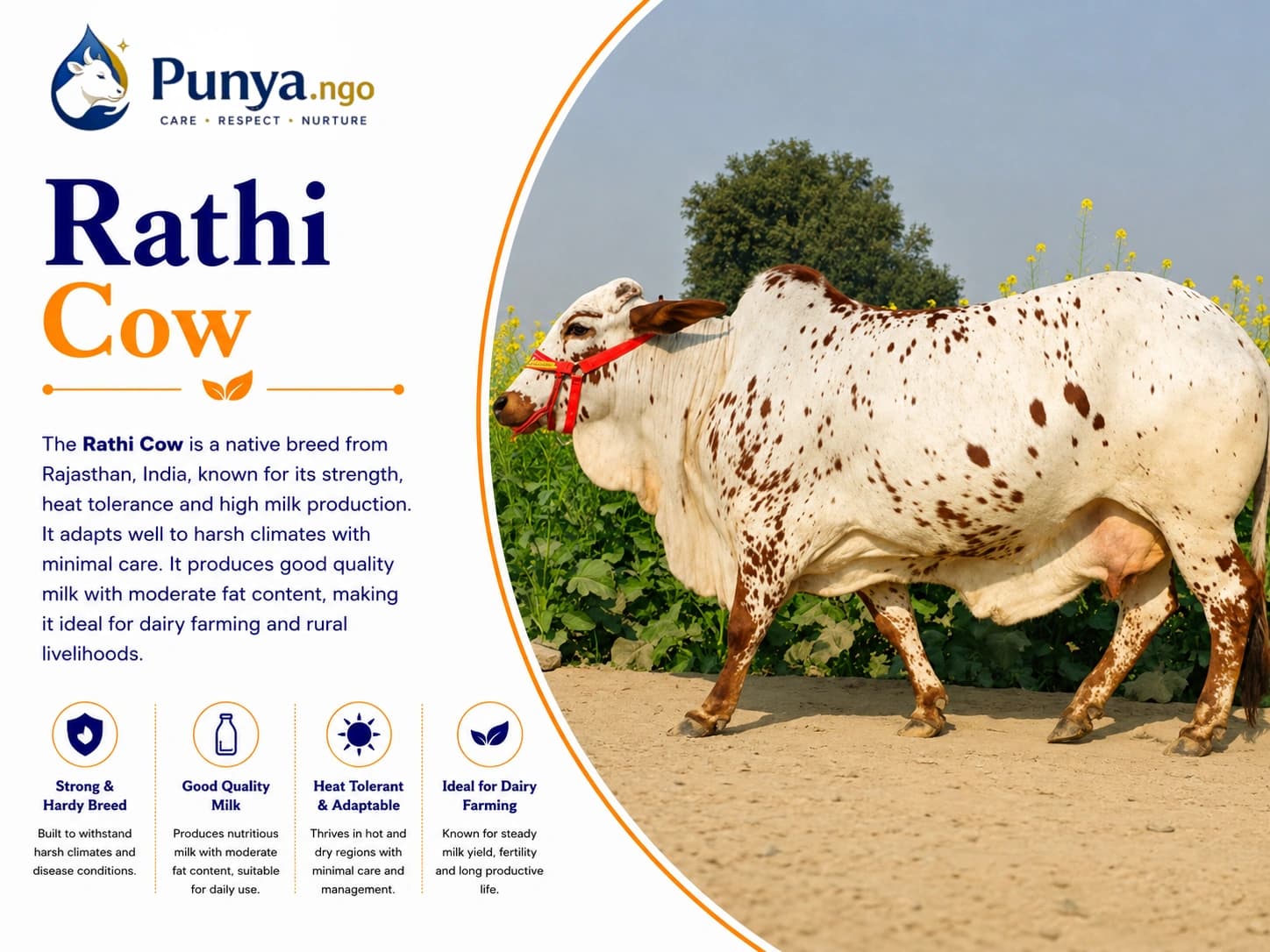
The Rathi Cow Breed in India has a distinctive appearance that helps farmers identify it easily.
Common Physical Traits
- Medium-sized body
- Well-developed udder
- Strong legs and hooves
- Moderately long face
- Medium-sized horns
- Alert expression
Coat Color
The breed typically shows:
- Brown with white patches
- White with brown markings
- Black and white patterns in some animals
The color variation is one of the unique visual characteristics of the breed.
Takeaway: Rathi Cow Breed in India is easily recognized by its patchy coat patterns and dairy-oriented body structure.
Milk Production and Dairy Value
One of the biggest strengths of the Rathi Cow Breed in India is its milk-producing ability.
Under proper feeding and management conditions, the breed can provide good milk yields while requiring fewer inputs than many exotic breeds.
Milk Production Highlights
| Parameter | Typical Range |
|---|---|
| Average Lactation Yield | 1,500–2,500 kg |
| Daily Milk Yield | 5–10 liters |
| Lactation Performance | Consistent |
| Dairy Utility | High |
Milk production varies depending on:
- Nutrition
- Genetics
- Farm management
- Health care
- Environmental conditions
The breed is especially valued by small and medium dairy farmers who prefer dependable performance over maximum production.
Takeaway: Rathi Cow Breed in India offers reliable milk production with relatively lower management pressure.
Temperament and Behavior
The Rathi Cow Breed in India is generally known for its manageable temperament.
Behavioral Traits
- Calm nature
- Easy handling
- Good adaptability to village farming systems
- Responsive to routine management
These qualities make the breed suitable for family-operated dairy farms and traditional rural cattle management systems.
Takeaway: The breed's manageable behavior makes everyday dairy operations easier.
Climate Adaptability
Climate adaptability is one of the strongest reasons behind the popularity of the Rathi Cow Breed in India.
Adaptation Strengths
- High heat tolerance
- Ability to withstand dry climates
- Efficient utilization of available fodder
- Better survival under water-limited conditions
The breed evolved in Rajasthan's harsh environment, making it naturally resilient.
This resilience helps farmers maintain productivity even during difficult weather conditions.
Takeaway: Rathi Cow Breed in India performs exceptionally well in hot and dry regions.
Feeding and Management
Although the Rathi Cow Breed in India is hardy, proper nutrition significantly improves performance.
Feeding Recommendations
- Green fodder
- Dry fodder
- Crop residues
- Mineral mixture
- Clean drinking water
Management Practices
- Regular vaccination
- Deworming schedule
- Clean housing
- Proper milking hygiene
- Balanced feeding
Good management improves both milk production and overall health.
Takeaway: Consistent feeding and preventive healthcare maximize the breed's productivity.
Advantages of Rathi Cow Breed in India
Key Benefits
- Strong heat tolerance
- Good milk production
- Indigenous genetic strength
- Lower adaptation stress
- Suitable for rural farming
- Performs under resource-limited conditions
- Supports sustainable dairy systems
The breed offers a practical balance between productivity and resilience.
Takeaway: Rathi Cow Breed in India is valued because it combines dairy utility with environmental adaptability.
Limitations or Practical Considerations
No cattle breed is perfect, and the Rathi Cow Breed in India also has certain limitations.
Considerations for Farmers
- Milk yield may be lower than specialized exotic dairy breeds.
- Performance depends heavily on nutrition and management.
- Availability of purebred animals may be limited outside Rajasthan.
Farmers should select the breed based on local conditions rather than assuming it is the best option everywhere.
Takeaway: The breed excels in suitable environments but may not match intensive dairy breeds for maximum milk output.
Best Use Cases for Farmers
The Rathi Cow Breed in India is particularly suitable for:
Ideal Farming Situations
- Dairy farms in hot regions
- Semi-arid farming systems
- Rural farming operations
- Small and medium dairy enterprises
- Indigenous cattle conservation programs
Farmers looking for long-term sustainability often find the breed a practical choice.
Takeaway: Rathi Cow Breed in India works best where climate resilience is as important as milk production.
Comparison with Similar Indian Cow Breeds
Rathi vs Tharparkar
| Feature | Rathi | Tharparkar |
|---|---|---|
| Main Utility | Milch | Dual Purpose |
| Native Region | Rajasthan | Rajasthan & Sindh Region |
| Heat Tolerance | High | High |
| Milk Production | Good | Good |
| Adaptability | Excellent | Excellent |
Rathi vs Sahiwal
| Feature | Rathi | Sahiwal |
|---|---|---|
| Milk Yield | Moderate to Good | Higher |
| Climate Tolerance | Very High | High |
| Management Requirement | Moderate | Moderate |
| Suitability for Dry Areas | Excellent | Good |
The right breed depends on farm goals, climate, and resource availability.
Takeaway: Rathi Cow Breed in India stands out for its adaptability, while some breeds may offer higher milk output under intensive systems.
Conclusion
The Rathi Cow Breed in India remains one of the country's most valuable indigenous dairy breeds. Originating from Rajasthan's harsh environment, it has developed exceptional heat tolerance, adaptability, and dependable milk production.
For farmers operating in dry and semi-arid regions, the breed offers a practical and sustainable dairy solution. While it may not always produce the highest milk volumes compared to specialized dairy breeds, its resilience and lower adaptation risk make it highly relevant for Indian farming conditions.
Takeaway: Rathi Cow Breed in India is a dependable indigenous dairy breed that delivers practical value where resilience matters most.
FAQs
1. What is Rathi Cow Breed in India?
It is an indigenous dairy cattle breed from Rajasthan known for milk production and climate adaptability.
Takeaway: It is a recognized Indian milch breed.
2. Where did the Rathi Cow Breed in India originate?
The breed originated in Rajasthan, particularly in the Bikaner and Ganganagar regions.
Takeaway: Rajasthan is the native home of the breed.
3. How much milk does a Rathi cow produce?
Milk yield commonly ranges between 5 and 10 liters per day under good management.
Takeaway: The breed provides reliable dairy performance.
4. Is the Rathi Cow Breed in India suitable for hot climates?
Yes. It is highly adapted to hot and semi-arid environments.
Takeaway: Heat tolerance is one of its strongest traits.
5. What is the primary use of the breed?
Its primary purpose is milk production.
Takeaway: It is mainly a dairy breed.
6. Is the breed suitable for small farmers?
Yes. Its adaptability and manageable requirements make it suitable for small and medium dairy farms.
Takeaway: It fits well into traditional rural farming systems.
7. How does Rathi compare with Sahiwal?
Sahiwal may produce higher milk yields, while Rathi often performs better under harsh dry conditions.
Takeaway: Breed selection should match farm conditions.
8. Why is the Rathi Cow Breed in India important?
It contributes to dairy farming, indigenous cattle conservation, and sustainable agriculture.
Takeaway: The breed combines productivity with long-term sustainability.